
tree-trimming · Oklahoma City, OK
Thinning an Ornamental Japanese Maple in Oklahoma City
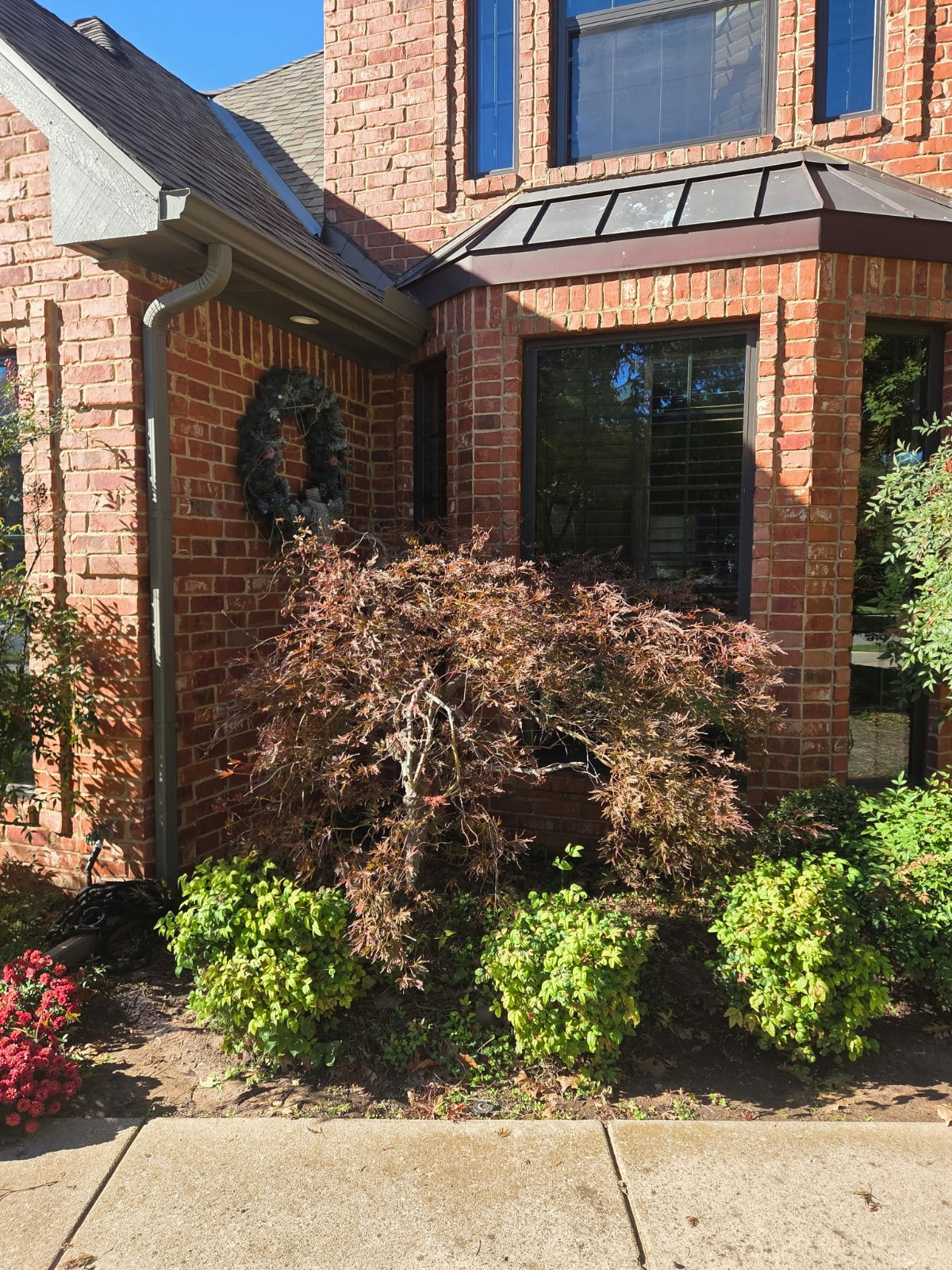
A homeowner in Oklahoma City called us to address an overgrown weeping Japanese maple crowding their front entryway foundation bed. Years of dense interior growth had turned the specimen into a tangled thicket, choking off airflow and masking its natural branching architecture. Our certified arborists thinned the canopy from the inside out to restore structure, sunlight penetration, and plant vigor.
The challenge
The homeowner had planted this dissectum Japanese maple years ago as the focal accent beneath the bay window of their brick home. Over several growing seasons without targeted pruning, the canopy thickened into a solid, congested mound of twigs and overlapping foliage. What began as a graceful weeping specimen had started swallowing the surrounding foundation plantings and crowding the brickwork. The client loved the maple and did not want it sheared into a rounded hedge or hacked back with power tools. They noticed dead interior wood collecting inside the crown and wanted an arborist to thin it correctly so the tree could thrive for decades to come.
Our approach
Weeping Japanese maples have delicate branch structures that tend to layer directly on top of each other. When left unpruned, top layers shade out lower interior twigs. The shaded wood dies off inside, trapping dead leaves and creating an ideal environment for moisture-loving fungal pathogens and scale insects. Beyond pest and disease risk, an overly dense canopy acts like a sail in central Oklahoma winds and catches heavy snow and ice loads during winter storms. The added weight pulls directly on weak branch unions, leading to torn limbs and permanent structural damage.
The result
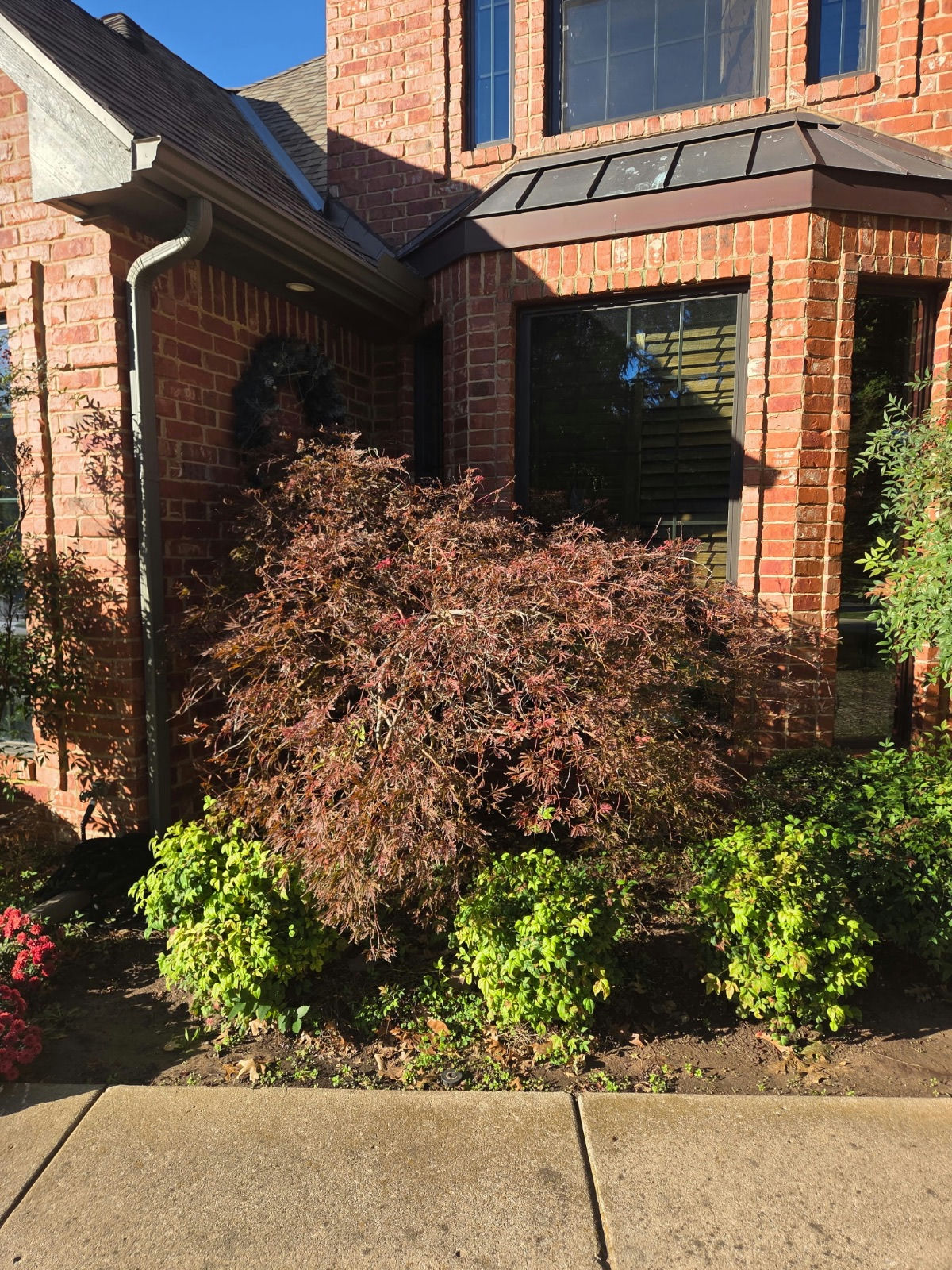
Pruning ornamental maples requires patience and hand tools. We never use mechanical hedge trimmers on specimen trees. Working from the ground up, we got underneath the canopy to inspect the primary scaffold branches and establish our pruning strategy before making any cuts. First, we removed dead, diseased, and dying twigs from the interior core. Next, we systematically addressed crossing, rubbing, and downward-growing branches that created structural interference. We used clean bypass hand pruners to cut back to healthy branch collars or outward-facing lateral buds, preserving natural flow while opening pockets of negative space. Finally, we reduced select cascading tips to maintain clearance above the sidewalk and adjacent shrubs without creating flat or blunt edges. The result exposes the elegant, twisted trunk line and allows sunlight to filter through the canopy to the roots and surrounding beds.
THE BACKSTORY
The homeowner had planted this dissectum Japanese maple years ago as the focal accent beneath the bay window of their brick home. Over several growing seasons without targeted pruning, the canopy thickened into a solid, congested mound of twigs and overlapping foliage. What began as a graceful weeping specimen had started swallowing the surrounding foundation plantings and crowding the brickwork. The client loved the maple and did not want it sheared into a rounded hedge or hacked back with power tools. They noticed dead interior wood collecting inside the crown and wanted an arborist to thin it correctly so the tree could thrive for decades to come.
THE PROBLEM WITH CONGESTED CANOPIES
Weeping Japanese maples have delicate branch structures that tend to layer directly on top of each other. When left unpruned, top layers shade out lower interior twigs. The shaded wood dies off inside, trapping dead leaves and creating an ideal environment for moisture-loving fungal pathogens and scale insects. Beyond pest and disease risk, an overly dense canopy acts like a sail in central Oklahoma winds and catches heavy snow and ice loads during winter storms. The added weight pulls directly on weak branch unions, leading to torn limbs and permanent structural damage.
HOW WE APPROACHED THE PRUNING
Pruning ornamental maples requires patience and hand tools. We never use mechanical hedge trimmers on specimen trees. Working from the ground up, we got underneath the canopy to inspect the primary scaffold branches and establish our pruning strategy before making any cuts. First, we removed dead, diseased, and dying twigs from the interior core. Next, we systematically addressed crossing, rubbing, and downward-growing branches that created structural interference. We used clean bypass hand pruners to cut back to healthy branch collars or outward-facing lateral buds, preserving natural flow while opening pockets of negative space. Finally, we reduced select cascading tips to maintain clearance above the sidewalk and adjacent shrubs without creating flat or blunt edges. The result exposes the elegant, twisted trunk line and allows sunlight to filter through the canopy to the roots and surrounding beds.
THE RESULT
The tree was transformed from a tangled mass into an open, sculptural specimen. Air can now circulate freely through the interior branches, significantly lowering fungal pressure during humid Oklahoma summers. All twig debris was raked, bagged, and hauled off-site, leaving the walkway and front bed immaculate.
ORNAMENTAL TREE PRUNING IN CENTRAL OKLAHOMA
Ornamental trees like Japanese maples, redbuds, and dogwoods are sensitive investments in an urban landscape. Central Oklahoma presents specific weather challenges that make proper pruning habits essential. Here is what every OKC homeowner should know about maintaining small specimen trees:
SIGNS YOUR ORNAMENTAL TREE NEEDS ARBORIST THINNING
If you are unsure whether your landscape specimen needs attention, look for these structural and health indicators:
BEST PRACTICES FOR OKLAHOMA ORNAMENTALS
If you are planning your landscape or replacing overgrown shrubs, choose species that handle local clay soils and heat while delivering distinct seasonal form:
ornamental tree trimming and structural pruning in Oklahoma City
Next step
SCHEDULE AN ORNAMENTAL PRUNING VISIT IN OKC
Contact our ISA-Certified Arborists for fine pruning and canopy thinning. Call (405) 815-7959.