
tree-removal · Oklahoma City, OK
Removing a Hazardous Declining Oak in Oklahoma City
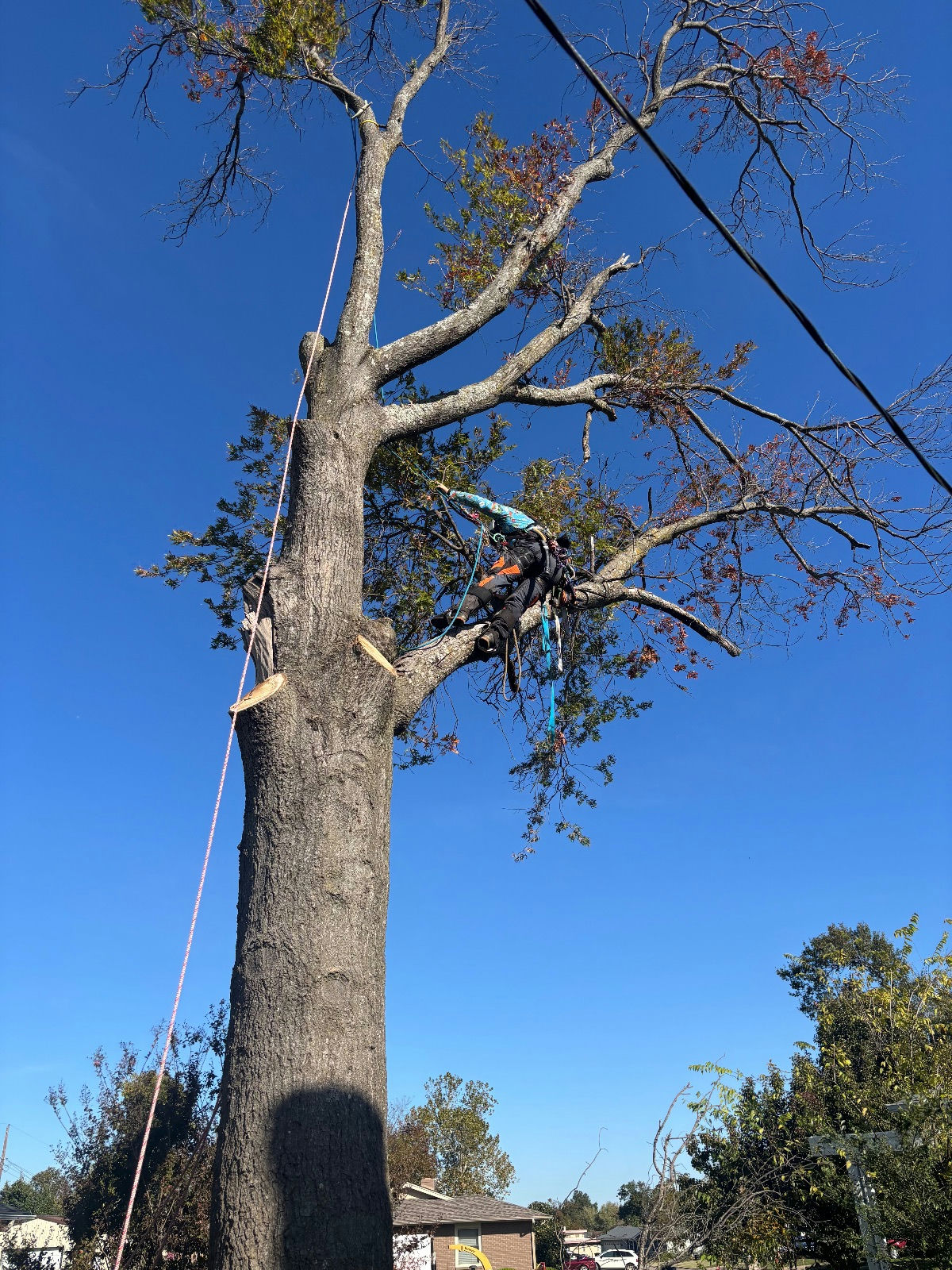
In a residential neighborhood in Oklahoma City, this mature red oak had reached the end of its safe lifespan. Severe crown dieback and previous limb tear-outs left large dead leaders looming directly over the home and overhead service lines. Our crew mobilized with climbing systems and precision rigging to dismantle the hazardous canopy piece by piece.
The challenge
This Oklahoma City homeowner watched this mature oak decline over several rough seasons. Summer drought stress paired with past ice load had torn out major lateral limbs, leaving ragged stubs and decay pockets along the upper trunk. The remaining canopy was rapidly losing foliage, showing classic upper-crown dieback. With branches hanging over the roofline and nearby utility service lines running directly through the drop zone, the homeowner could no longer wait out another Oklahoma storm season. They called Arbor Image to evaluate whether the tree could be pruned for risk mitigation or if full removal was the only responsible option.
Our approach
Our assessment confirmed extensive vascular decline and structural compromise. When large limbs tear out in storm events without clean compartmentalization, moisture enters the heartwood. Over time, internal rot undermines the load-bearing strength of the remaining leaders. In central Oklahoma, heavy wind gusts and sudden winter ice events put exponential torque on compromised canopy structures. A dead branch fails under static load; an entire decaying stem fails under wind shear. Given the target area—the home's roof, fence line, and adjacent utility wires—preserving this specific oak presented an unacceptable structural risk.
The result
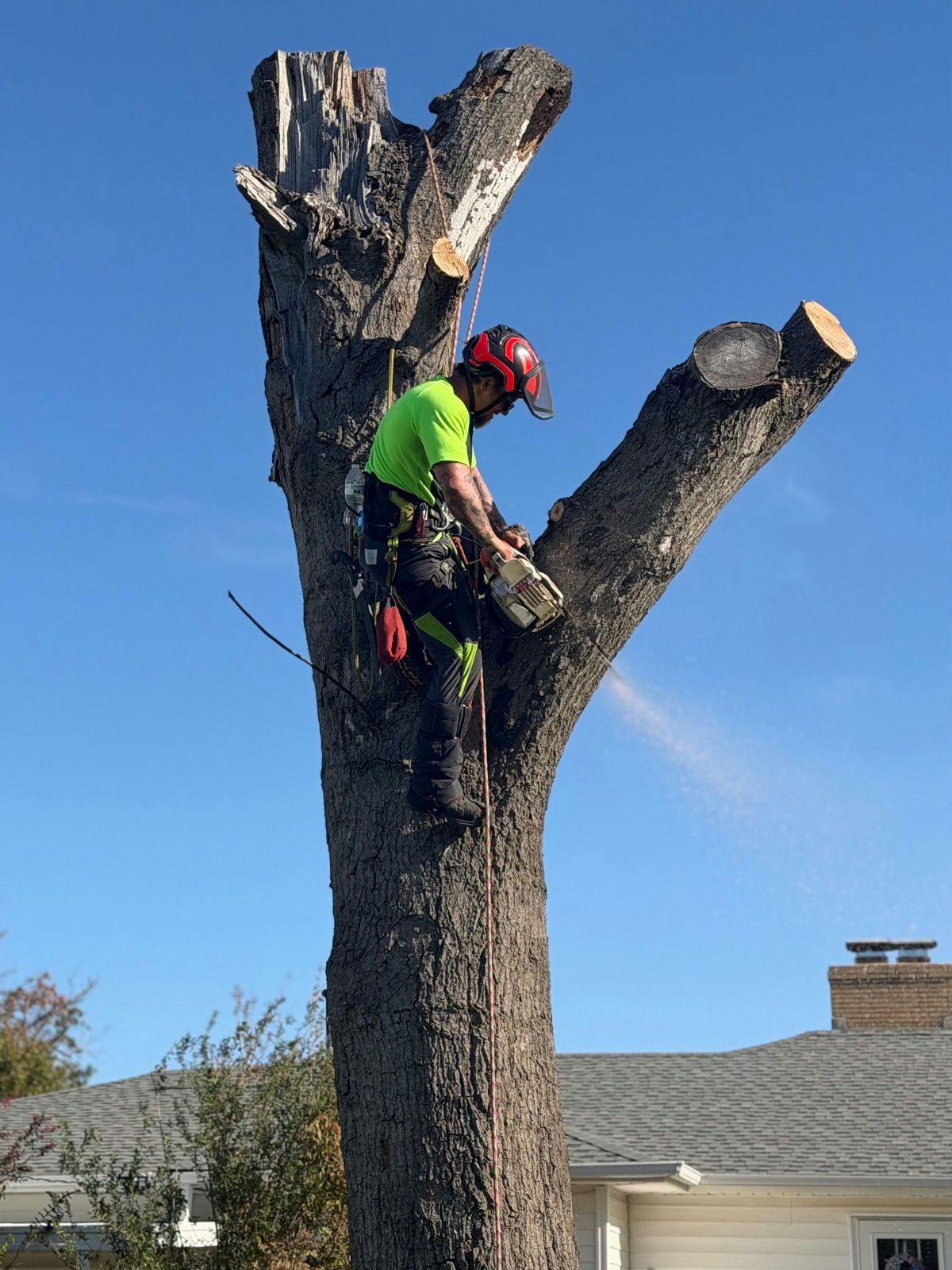
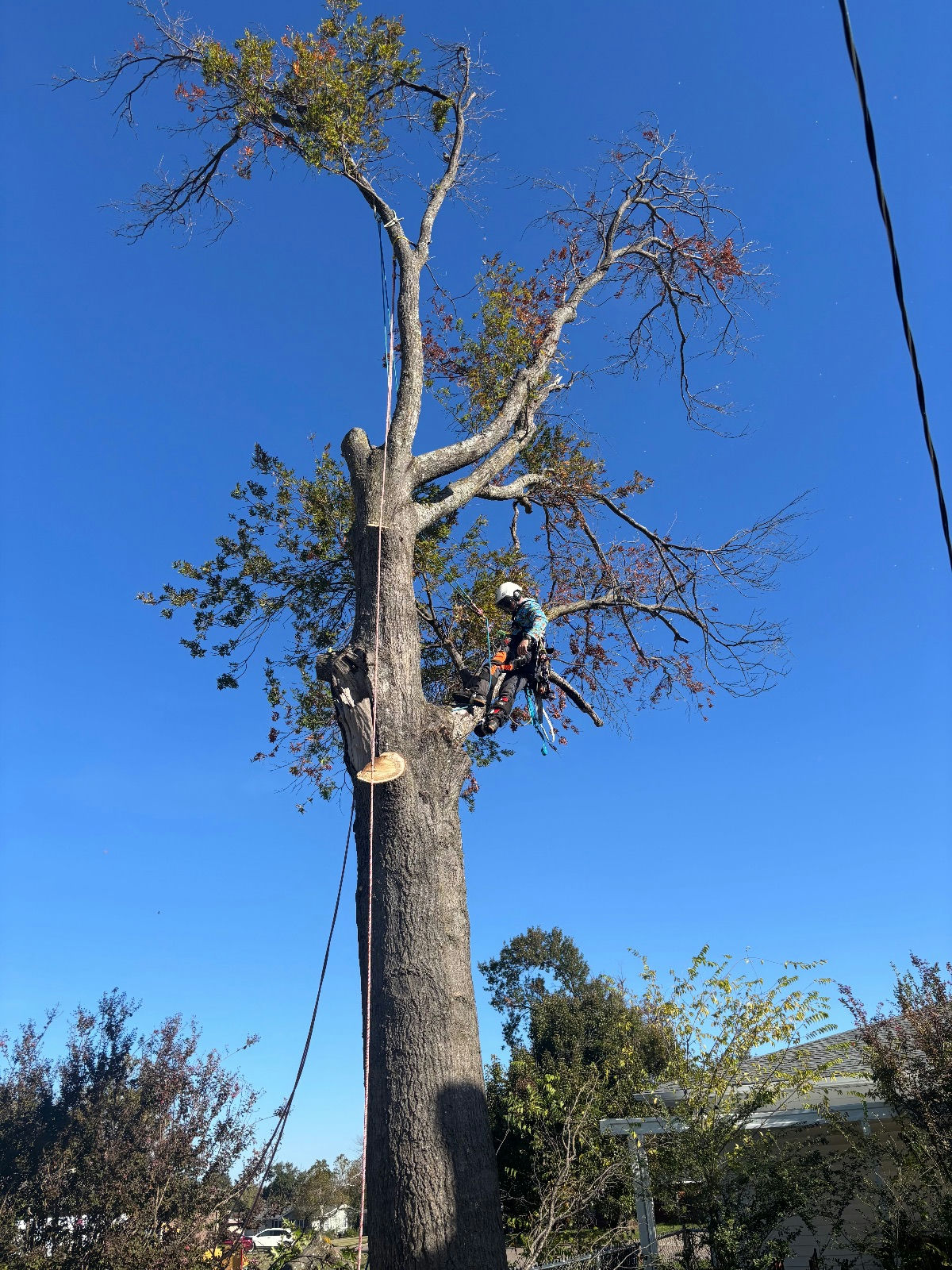
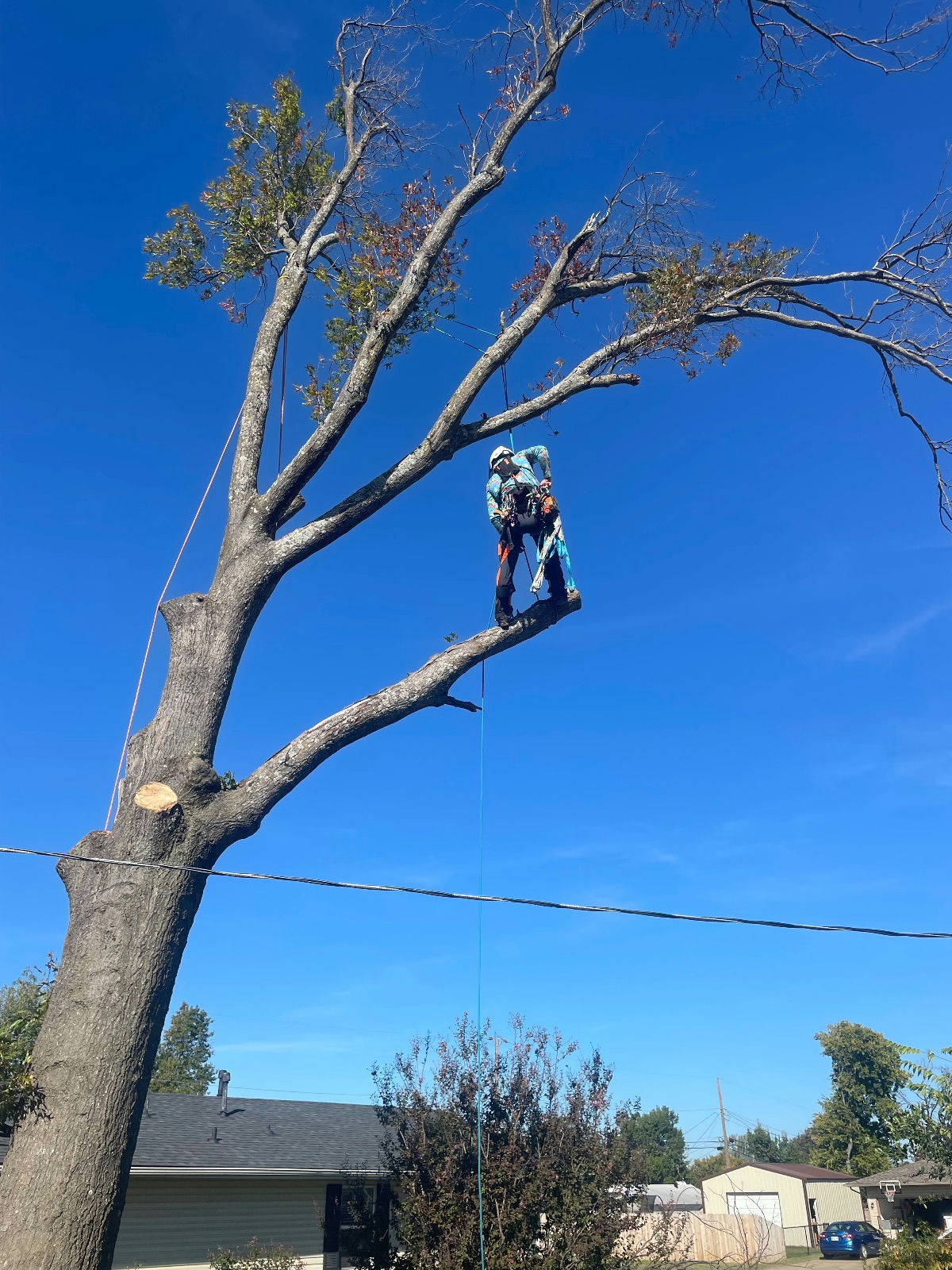
Tight backyard access and overhead power lines prevented bucket truck positioning, making this a technical climbing and rigging operation. Our arborist ascended into the canopy using modern SRT (Single Rope Technique) stationary rope systems, setting primary anchor points in the soundest available wood. We worked from the outside in. The climber limb-walked out on extended laterals, setting friction rigging and lowering lines to cut and lower heavy limbs smoothly into the yard. Every cut was pieced out in controlled sections to keep timber entirely clear of the roofline and power drops below. Once the outer canopy was stripped, we moved down to the main stems. As shown in the progression, our climber systematically blocked down the spar using undercut and bypass techniques, lowering timber chunks onto ground mats to protect the lawn. The trunk was dropped to ground level safely without a scratch on the surrounding structures.
THE BACKSTORY
This Oklahoma City homeowner watched this mature oak decline over several rough seasons. Summer drought stress paired with past ice load had torn out major lateral limbs, leaving ragged stubs and decay pockets along the upper trunk. The remaining canopy was rapidly losing foliage, showing classic upper-crown dieback. With branches hanging over the roofline and nearby utility service lines running directly through the drop zone, the homeowner could no longer wait out another Oklahoma storm season. They called Arbor Image to evaluate whether the tree could be pruned for risk mitigation or if full removal was the only responsible option.
THE PROBLEM
Our assessment confirmed extensive vascular decline and structural compromise. When large limbs tear out in storm events without clean compartmentalization, moisture enters the heartwood. Over time, internal rot undermines the load-bearing strength of the remaining leaders. In central Oklahoma, heavy wind gusts and sudden winter ice events put exponential torque on compromised canopy structures. A dead branch fails under static load; an entire decaying stem fails under wind shear. Given the target area—the home's roof, fence line, and adjacent utility wires—preserving this specific oak presented an unacceptable structural risk.
THE WORK
Tight backyard access and overhead power lines prevented bucket truck positioning, making this a technical climbing and rigging operation. Our arborist ascended into the canopy using modern SRT (Single Rope Technique) stationary rope systems, setting primary anchor points in the soundest available wood. We worked from the outside in. The climber limb-walked out on extended laterals, setting friction rigging and lowering lines to cut and lower heavy limbs smoothly into the yard. Every cut was pieced out in controlled sections to keep timber entirely clear of the roofline and power drops below. Once the outer canopy was stripped, we moved down to the main stems. As shown in the progression, our climber systematically blocked down the spar using undercut and bypass techniques, lowering timber chunks onto ground mats to protect the lawn. The trunk was dropped to ground level safely without a scratch on the surrounding structures.
THE RESULT
The hazardous canopy and massive trunk were completely dismantled without incident. Our ground crew chipped the brush, raked the turf clean of twigs and sawdust, and hauled the heavy rounds off-site. The homeowner gained total peace of mind, eliminating a major hazard before the next severe weather front hit Oklahoma City.
OAK DECLINE IN CENTRAL OKLAHOMA
Mature oaks are the backbone of the Oklahoma City urban forest, but they face intense environmental pressures that can trigger irreversible decline. Understanding early warning signs helps homeowners act before a tree becomes an active emergency.
SIGNS YOUR TREE MAY BE A STRUCTURAL HAZARD
A declining tree does not always need immediate removal, but signs of active structural decay require a formal risk assessment by an ISA-Certified Arborist. Here are key indicators that an oak is transitioning from salvageable to hazardous:
professional tree removal and preservation in the Oklahoma City metro
Next step
SCHEDULE TREE REMOVAL IN OKLAHOMA CITY
Reach out to Arbor Image Tree Care for an on-site evaluation and transparent quote. Call (405) 815-7959 to protect your home.