
tree-health · Yukon, OK
Restoring Browning Arborvitae in Yukon with Plant Health Care
A Yukon homeowner invested heavily in an evergreen privacy border along their property line, only to notice interior browning and needle drop spreading through the canopy. Because these trees were already enrolled in our plant health care program, our certified arborists caught the fungal needle blight early before irreversible dieback occurred. We delivered a targeted therapeutic foliar application to protect new growth and restore canopy vitality.
The challenge
The homeowner planted these upright evergreens to establish an all-season privacy screen and windbreak between their back patio and neighboring acreage. In central Oklahoma, getting landscape conifers established is hard work. Heavy clay soils, drying southern winds, and intense summer heat create a challenging environment for nursery-grown stock. When patches of bronze and brown began appearing within the lower and interior canopy, the owner grew concerned. Evergreen dieback can spread fast once it takes hold. Instead of waiting until entire sections died off, they notified us as part of their scheduled plant health care monitoring visits.
Our approach
Needle browning on ornamental conifers like arborvitae and cypress in Canadian County typically points to one of three culprits: fungal needle blight (such as Cercospora or Kabatina), spider mite infestations, or root-zone moisture stress in dense clay soils. During humid spring and late-summer stretches, fungal spores easily colonize dense interior branches where airflow is restricted and morning dew lingers. Left unmanaged, needle blight moves from the interior branchlets outward. Conifers do not easily regenerate foliage on old, bare wood. Once an interior branch dies back completely, it leaves a permanent hollow pocket in your hedge or privacy screen. Stopping the pathogen cycle early is the only way to safeguard the structural density of the tree.
The result
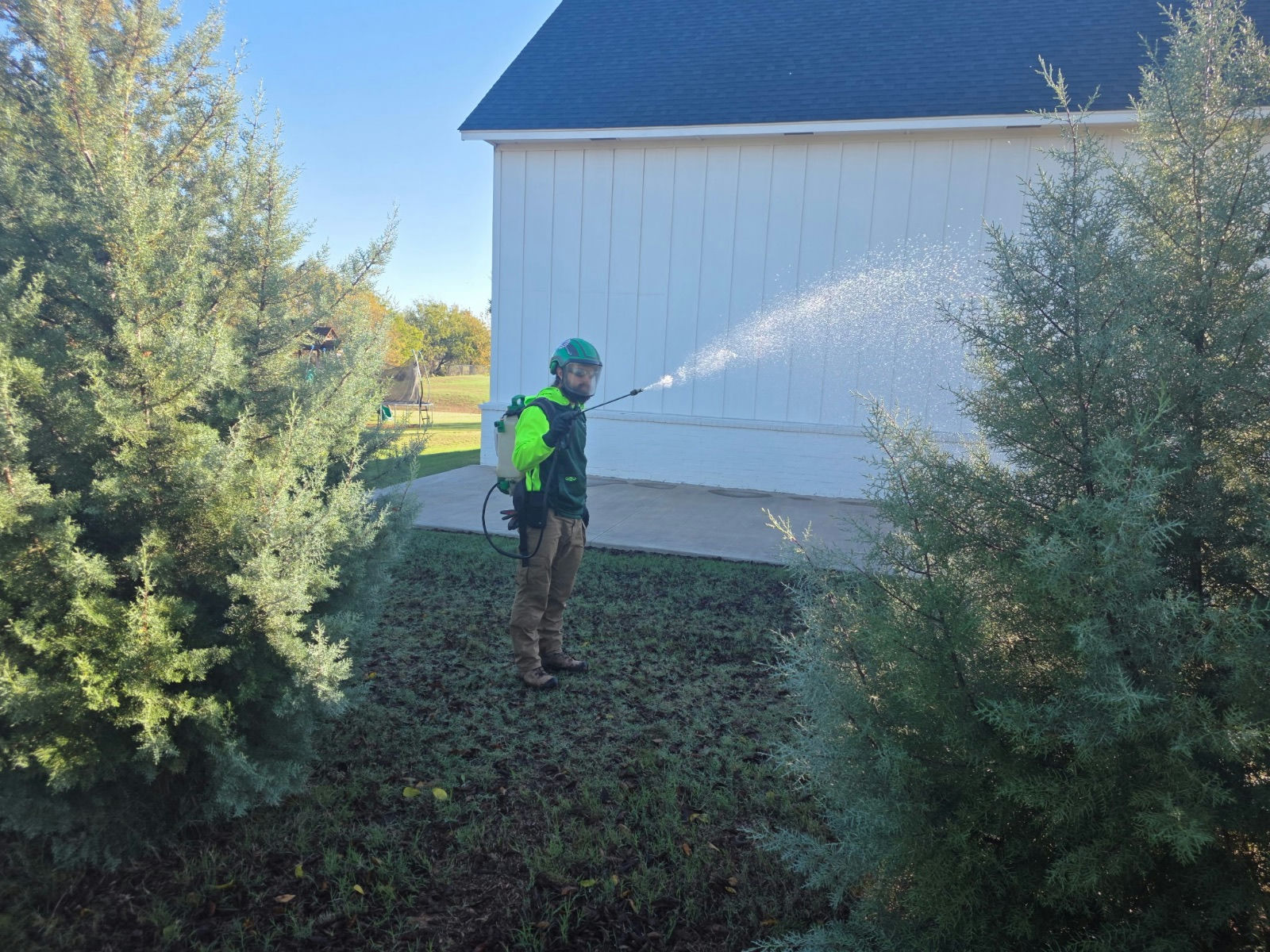
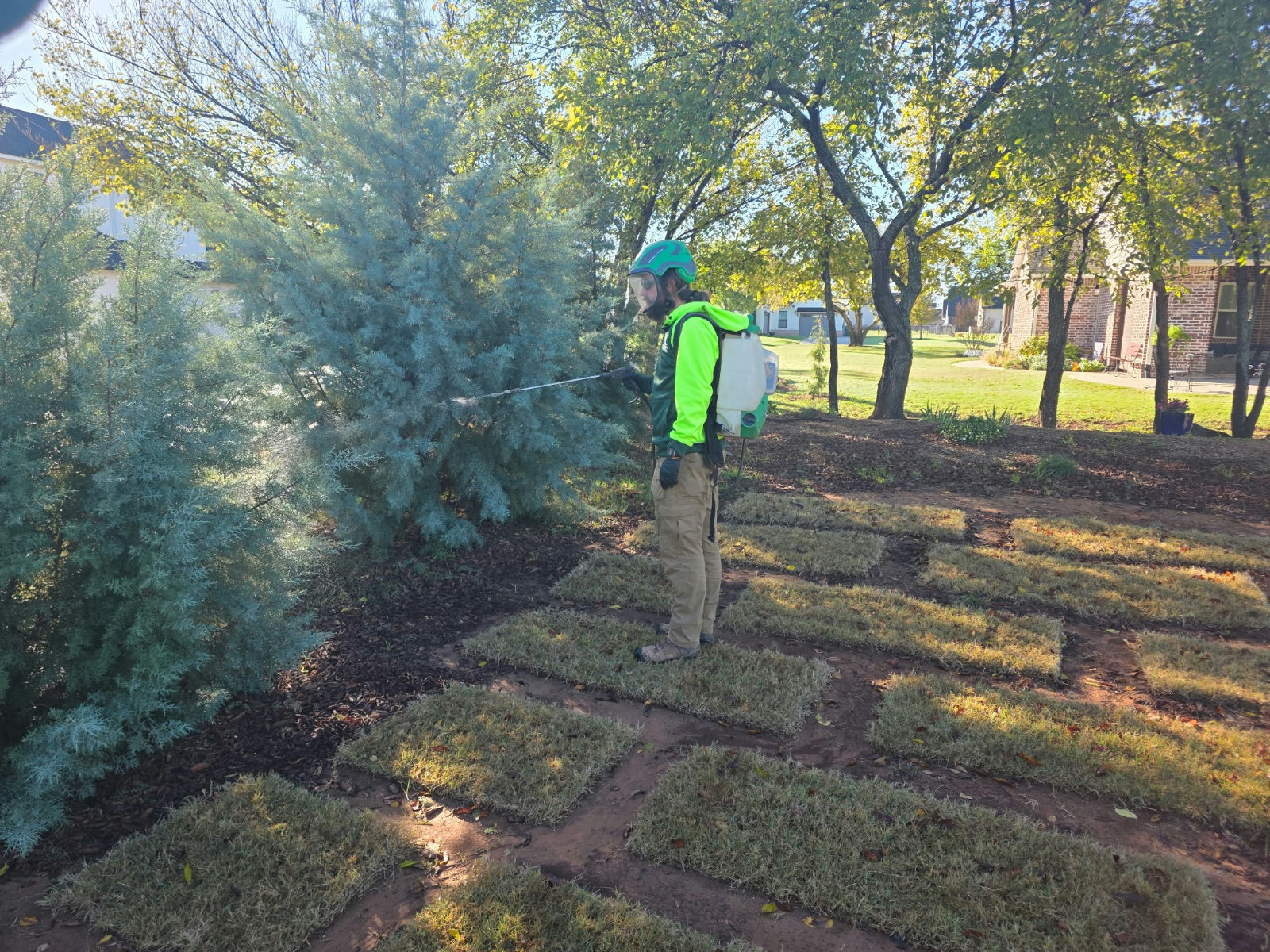
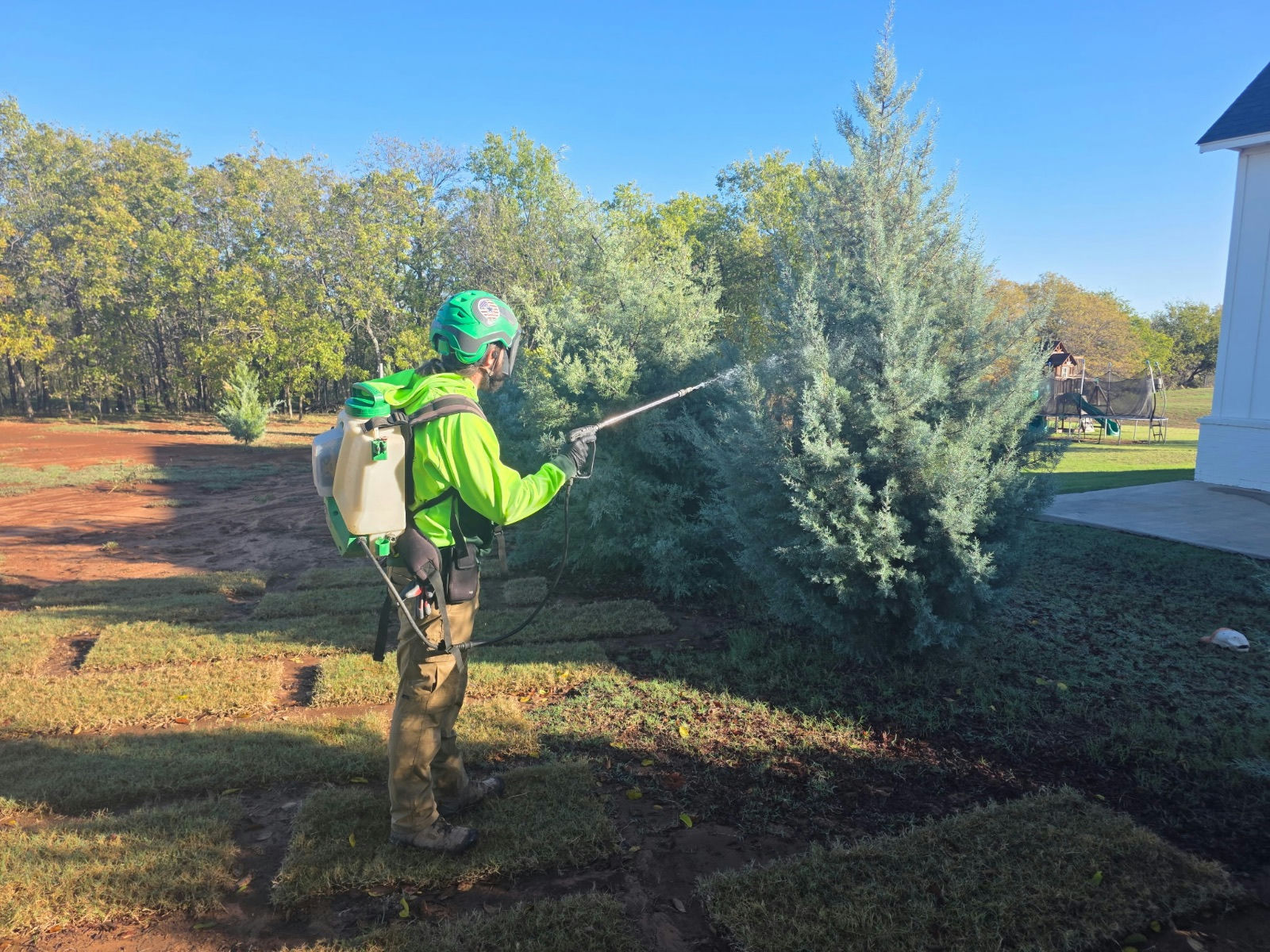
Our ISA-Certified Arborist arrived equipped with personal protective equipment, full face protection, and a calibrated motorized backpack sprayer. Spraying evergreens requires thorough coverage: misting only the outer perimeter fails to reach the fungal spores and mite colonies hiding deep in the interior scaffolding branches. We applied a targeted therapeutic fungicide and micronutrient solution formulated specifically for evergreen foliar disease in central Oklahoma soils. Working methodically around each specimen, our technician directed the spray angle upward into the branch whorls and down through the top terminal leaders, ensuring complete saturation of the foliage without excessive ground runoff. Because new sod plugs had recently been installed adjacent to the bed, we carefully managed application pressure and drift. Our treatment targeted only the canopy tissue, preserving surrounding turf and landscape plantings while halting pathogen reproduction on the needle surfaces.
THE BACKSTORY
The homeowner planted these upright evergreens to establish an all-season privacy screen and windbreak between their back patio and neighboring acreage. In central Oklahoma, getting landscape conifers established is hard work. Heavy clay soils, drying southern winds, and intense summer heat create a challenging environment for nursery-grown stock. When patches of bronze and brown began appearing within the lower and interior canopy, the owner grew concerned. Evergreen dieback can spread fast once it takes hold. Instead of waiting until entire sections died off, they notified us as part of their scheduled plant health care monitoring visits.
THE PROBLEM
Needle browning on ornamental conifers like arborvitae and cypress in Canadian County typically points to one of three culprits: fungal needle blight (such as Cercospora or Kabatina), spider mite infestations, or root-zone moisture stress in dense clay soils. During humid spring and late-summer stretches, fungal spores easily colonize dense interior branches where airflow is restricted and morning dew lingers. Left unmanaged, needle blight moves from the interior branchlets outward. Conifers do not easily regenerate foliage on old, bare wood. Once an interior branch dies back completely, it leaves a permanent hollow pocket in your hedge or privacy screen. Stopping the pathogen cycle early is the only way to safeguard the structural density of the tree.
HOW WE APPROACHED IT
Our ISA-Certified Arborist arrived equipped with personal protective equipment, full face protection, and a calibrated motorized backpack sprayer. Spraying evergreens requires thorough coverage: misting only the outer perimeter fails to reach the fungal spores and mite colonies hiding deep in the interior scaffolding branches. We applied a targeted therapeutic fungicide and micronutrient solution formulated specifically for evergreen foliar disease in central Oklahoma soils. Working methodically around each specimen, our technician directed the spray angle upward into the branch whorls and down through the top terminal leaders, ensuring complete saturation of the foliage without excessive ground runoff. Because new sod plugs had recently been installed adjacent to the bed, we carefully managed application pressure and drift. Our treatment targeted only the canopy tissue, preserving surrounding turf and landscape plantings while halting pathogen reproduction on the needle surfaces.
THE RESULT
The foliar treatment halted active spore sporulation across the privacy row, protecting this season's flush of new growth from secondary infection. Under our ongoing plant health care program, these trees receive regular seasonal assessments, root-zone health checks, and scheduled booster sprays. The homeowner preserved their substantial landscape investment and kept their living privacy wall intact.
EVERGREENS IN CENTRAL OKLAHOMA — THE HONEST TAKE
Arborvitae, Arizona cypresses, and eastern redcedars are frequently planted across the Oklahoma City metro for privacy, but keeping them thriving in Canadian and Oklahoma counties demands active stewardship. Our red clay holds water in the winter and bakes into a brick in July, stressing root systems and predisposing conifers to foliar pathogens. Understanding what your trees are up against helps you distinguish normal seasonal needle drop from dangerous disease outbreaks. Here is what our arborists look for on every site visit:
WARNING SIGNS TO MONITOR ON CONIFERS
If you maintain evergreens on your property, monitor them monthly through spring and fall. Look for these specific indicators that warrant professional arborist evaluation:
SIGNS OF CONIFER DECLINE IN OKLAHOMA
Knowing the difference between normal maturation and active pathogens protects your landscape from catastrophic loss. Catching issues early keeps treatment costs minimal and avoids tree replacement.
RECOMMENDED SCREENING SPECIES FOR CANADIAN COUNTY
When planning an evergreen hedge or replacing struggling arborvitae in Yukon, choosing species adapted to alkaline clay and high winds makes all the difference. We recommend these proven selections for long-term durability:
WHAT TO WATCH FOR NEXT
Evergreen care does not stop after a single spray application. We advise Yukon homeowners to run drip irrigation during extended winter dry spells, avoid overhead lawn irrigation that wets foliage, and inspect branch interiors for bagworm cocoons starting in early June. Regular plant health care visits ensure small stresses never turn into dead trees.
tree-health and plant health care programs in Edmond and Oklahoma City
Next step
SCHEDULE A PLANT HEALTH CARE VISIT IN YUKON
Protect your valuable evergreens before seasonal decline sets in. Call Arbor Image Tree Care at (405) 815-7959 to schedule an inspection.